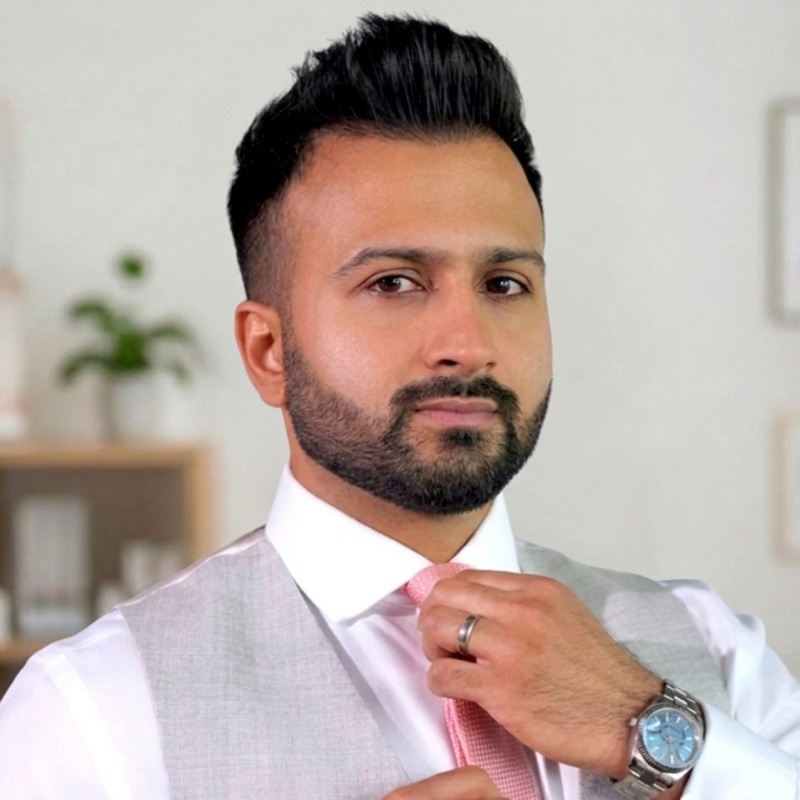
Dr Irtiza Ali Shah
Hair Transplant Surgeon
GMC 7554414
We’d like to use cookies to understand how our website is used and to measure our Google advertising. They’re only set if you agree. Essential settings, such as remembering this choice, are always used. Find out more.
Follicular unit extraction (FUE) hair transplants for a receding hairline, thinning crown, or a patchy beard or eyebrows, with hair transplant surgeon Dr Irtiza Ali Shah. Carried out here at Vale under local anaesthetic, after a free consultation.
Free consultation first · GMC-registered surgeon · CQC-registered clinic on Vale Road
Hair loss is very common. In men it usually follows a pattern, starting at the temples or the crown. Women more often notice general thinning, particularly along the parting. Genes and hormones play the biggest part, but stress, illness, some medicines and low iron can also contribute.
A hair transplant can restore hair to areas where it has thinned, using your own hair. It isn’t right for everyone, so we start with a free consultation to look at your hair loss, your donor hair and what you’d like to achieve.
Book a free consultationIn follicular unit extraction (FUE), individual groups of hair follicles, called grafts, are taken one by one from the back and sides of the head, where hair is usually resistant to thinning. They’re then placed into tiny openings in the thinning areas, at angles that match your natural hair.
The procedure is carried out under local anaesthetic, so you’re awake but comfortable, and usually takes one day, depending on how many grafts you need. FUE leaves tiny dot-like marks in the donor area rather than a single linear scar.
Rebuilding the hairline at the temples and front, designed to suit your age and face.
Adding density to the crown (vertex), where thinning often starts.
Stable pattern hair loss with enough healthy donor hair at the back and sides.
Some patterns of thinning in women, after a careful assessment of the cause.
Filling patchy or sparse areas of the beard and moustache with hair from the scalp.
Restoring thin or over-plucked eyebrows, with each hair placed to follow the natural direction of growth.
We discuss your hair loss and goals, look at your donor area, and explain how many grafts you may need and the cost.
Dr Shah designs your new hairline and plans the graft placement with you, so you know what to expect.
Under local anaesthetic, grafts are taken from the donor area and placed in the thinning areas. You go home the same day.
Scabs settle within about ten days. New growth usually starts at 3 to 4 months, with the full result at around 9 to 12 months.
| When | What to expect |
|---|---|
| Day 1 | You go home with dressings and written aftercare. |
| Days 2 to 10 | Small scabs form and settle. You’ll wash your hair gently as instructed. |
| Weeks 2 to 6 | The transplanted hairs shed. This is normal; the follicles stay in place. |
| Months 1 to 3 | A resting phase, when there may be little visible change. |
| Months 3 to 4 | New hair starts to grow. |
| Months 9 to 12 | Most people see the full result. It can take longer at the crown. |
We invite you back for follow-up appointments to check how your hair is growing.
A hair transplant works best for people whose hair loss has stabilised and who have enough healthy donor hair. If your hair loss is very early, very extensive or caused by a medical condition, another approach may be better, and we’ll tell you honestly.
We recommend taking time after your consultation to think about it before booking your procedure.
Hair Transplant Surgeon
GMC 7554414
Dr Irtiza Ali Shah is a hair transplant surgeon registered with the General Medical Council. He carries out FUE hair transplants for both men and women, and plans every hairline individually.
You’ll meet Dr Shah before your procedure to plan your treatment, and he carries out the procedure himself.



The local anaesthetic injections can sting for a short time. After that, most people feel little more than pressure. The scalp may be sore and tight for a few days afterwards, and we’ll advise you on painkillers.
It depends on the size of the area, how thin it is and how much donor hair you have. We’ll give you an estimate at your free consultation. Our packages cover 500 to 1,000, 1,000 to 1,500 and 1,500 to 2,000 grafts.
The transplanted hairs usually shed in the first few weeks, which is normal. New growth typically starts at 3 to 4 months, and most people see the full result at around 9 to 12 months. It can take longer at the crown.
Swelling of the forehead, scabbing, redness and numbness of the scalp are common for a short time. Less common risks include infection, inflamed hair follicles, temporary thinning of nearby hair (shock loss), visible marks in the donor area and some grafts not growing. You may not be happy with the density achieved. Dr Shah explains the risks in detail before you decide.
It can. A transplant doesn’t stop hair loss in the surrounding hair, so some people are advised to use medical treatment as well. We’ll talk this through at your consultation, so your new hairline still looks natural in years to come.
Many people return to work within a few days. You may prefer to wait until the redness and scabs have settled, usually around ten days.
Yes. Dr Shah uses the same FUE technique to fill patchy beards and moustaches and to restore thin eyebrows, usually taking hair from the back of the scalp. Transplanted hairs keep the character of scalp hair, so eyebrow hairs need regular trimming. The price depends on the number of grafts and is given at your consultation.
Interest-free finance over 12 months may be available for treatments over £1,500, subject to status.
Start with a free consultation to find out whether a hair transplant is right for you.
Hair transplants are only available to adults aged 18 and over. Results vary from person to person, and depend on your hair type and the amount of donor hair available. Written by Dr Irtiza Ali Shah, Hair Transplant Surgeon (GMC 7554414). Last updated 15 October 2026.