Gary Edwards
Injection Therapist and Chiropractor, Clinic Director
GCC 03996
We’d like to use cookies to understand how our website is used and to measure our Google advertising. They’re only set if you agree. Essential settings, such as remembering this choice, are always used. Find out more.
Platelet-rich plasma (PRP) is prepared from a small sample of your own blood and injected into a painful joint or tendon under ultrasound guidance. It’s an option for some people with knee arthritis or long-standing tendon pain.
Free consultation booked online · Prepared from your own blood · Ultrasound-guided
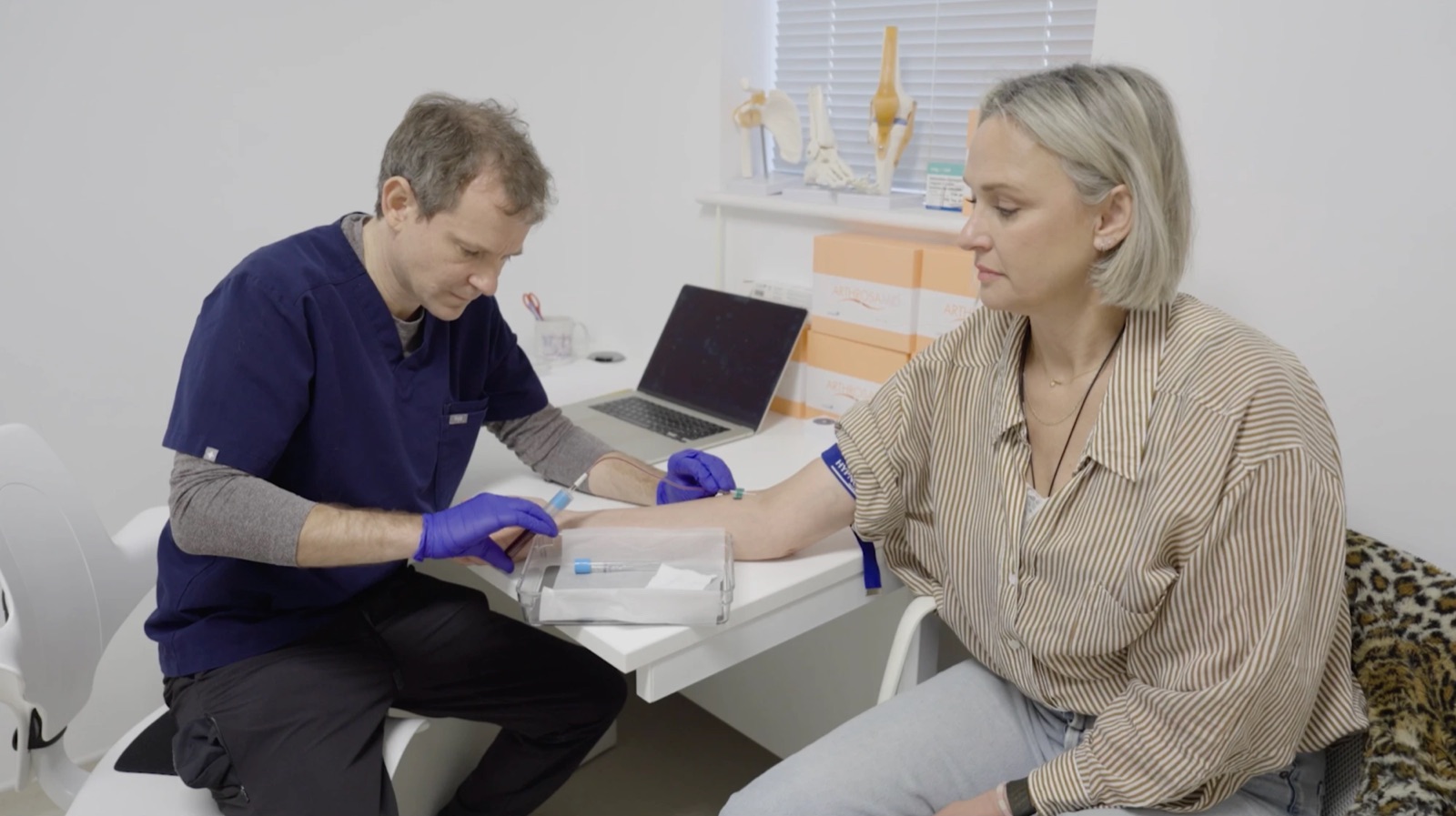
Your blood contains platelets, which help with clotting and release natural growth factors. To make PRP, we take a small sample of your blood and spin it in a centrifuge, which separates the platelets into a concentrated layer of plasma.
This plasma is then injected into the painful area. The aim is to support the body’s own healing response. Because it comes from your own blood, the risk of an allergic reaction is very low.
For mild to moderate arthritis, particularly when other treatments haven’t helped enough.
Long-standing tendon pain, such as tennis elbow, alongside an exercise programme.
For people who’d prefer not to keep having cortisone injections.
PRP for spinal joints and ligaments is available with Dr Azzini, from £1,500, after a free consultation.
We assess the problem, scan it with ultrasound and check PRP is suitable. The consultation is free.
We take a small blood sample from your arm, like a routine blood test.
Your blood is spun in a centrifuge in the clinic to concentrate the platelets.
The PRP is injected under ultrasound guidance. You can go home straight afterwards.
The research on PRP for knee arthritis is mixed:
PRP products and methods vary a lot between studies, which may explain some of the differences. We’ll give you an honest view of whether PRP is likely to help you, and what the alternatives are.
Seek urgent medical advice if the injected area becomes increasingly hot, red, swollen and painful, or you develop a fever. These can be signs of infection, which is rare but needs prompt treatment.
Injection Therapist and Chiropractor, Clinic Director
GCC 03996

Doctor, Sport & Exercise Medicine
GMC 7689922



I recently had an ultrasound guided cortisone injection with Gary… Gary took the time to explain everything clearly before the procedure which really put me at ease, not easy when you’re not a fan of needles! The process itself was essentially pain free.
Gary helped me with my frozen shoulder. He was very thorough, professional and informative. I was given a cortisone injection, which he talked me through. During the procedure he was calming and efficient.
I first saw Gary for a consultation regarding the arthritis in my knees with a view to having a hyaluronic acid injection. Gary was extremely knowledgeable and went through all the options before suggesting which would be the best option for me.
My mum had acute knee pain which has been treated at the clinic, she now has much better mobility and positive outlook due to the treatment received. Gary has been so helpful and supportive throughout the consultation and treatment.
I cannot thank Gary and Gabriel enough for the stem cell treatment they gave me. When I started my treatment my tendonitis was so bad in my elbows that I couldn’t carry my little children, drive the car or do my day job without getting in severe pain.
Real Google reviews, shortened. Individual results vary. Read all our reviews ↗
The blood test feels like any other. The injection can be uncomfortable for a short time, and the area may ache for a few days afterwards.
Soreness, swelling or bruising for a few days is common, and the pain can briefly feel worse before it improves. As with any injection, there’s a small risk of infection. We explain the risks before you decide.
It depends on the problem. Some people have one injection, others a short course. We’ll advise you at your consultation.
PRP works gradually, so any improvement usually builds over several weeks rather than days. Some people notice little or no change.
We usually advise avoiding anti-inflammatory medicines, such as ibuprofen, for a short time before and after PRP, as they may affect how platelets work. Paracetamol is usually fine. We’ll give you specific advice.
Book a free consultation online to find out if PRP is suitable for you.
Written by Gary Edwards, Injection Therapist (PG Cert Injection Therapy) and Chiropractor (GCC 03996). Last updated 15 October 2026.