We’d like to use cookies to understand how our website is used and to measure our Google advertising. They’re only set if you agree. Essential settings, such as remembering this choice, are always used. Find out more.
A non-invasive treatment for tendon and heel pain that hasn’t settled with rest and exercise, such as plantar fasciitis, tennis elbow and Achilles tendinopathy. We offer both radial and focused shockwave, and start with a free consultation to check which, if either, is right for you.
Free consultation · No needles or anaesthetic · CQC-registered clinic
A patient’s view
A patient on their shockwave treatment
Hear one of our patients describe their shockwave therapy and how their pain has been since. This is their personal experience, and results vary from person to person.
Extracorporeal shockwave therapy (ESWT) sends short pulses of acoustic energy through the skin into a painful tendon, or into the tissue where a tendon or the plantar fascia attaches to bone. Nothing is injected and the skin isn’t broken.
It’s mainly used for tendon problems that have lasted for months and haven’t settled with rest, stretching, strengthening exercises and changes to footwear or activity. It isn’t usually a first treatment.
How it works isn’t fully understood. The main ideas are that it stimulates a repair response in tissue that has stopped healing, and that it changes how pain signals are passed on from the area. Research results are mixed and vary from one condition to another, which is why we assess you properly before suggesting it.
Radial and focused shockwave: what’s the difference?
We have both types of shockwave at Vale, on a Storz Medical system, so we can choose the one that suits your problem.
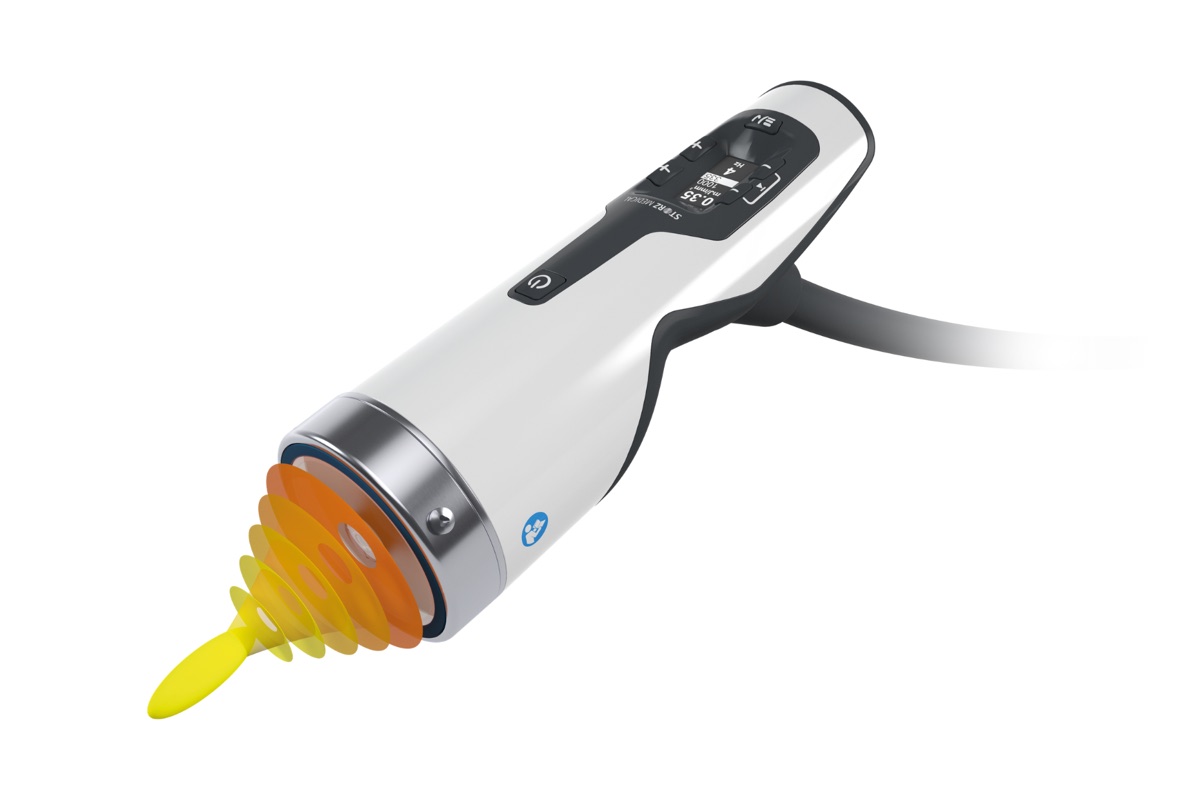
Focused shockwave: the energy narrows to a point beneath the skin.
Radial shockwave
Focused shockwave
How it’s produced
Compressed air fires a small projectile against the applicator tip, sending a pulse into the skin
An electromagnetic source in the handpiece generates a pulse and concentrates it
How the energy travels
Spreads outwards from the tip, strongest at the skin and fading within a few centimetres
Converges on a focal point, so the energy is highest beneath the skin rather than at it
Depth
Best for tissue close to the surface
The focal depth can be adjusted to reach deeper tissue
Best suited to
Larger areas of tendon or muscle near the surface
Smaller, deeper or more precisely located targets
Typical uses
Heel pain over a wider area, tennis and golfer’s elbow, tight muscle around a tendon
Deeper tendon problems, where a tendon attaches to bone, calcium deposits, the hip region
How it feels
A firm, spread-out tapping that can feel quite intense at the skin
A more pinpoint pressure; many people find it gentler on the skin because less energy is spent at the surface
Neither type is simply “stronger” or “better”; they work in different ways and suit different problems. The choice depends on what’s causing your pain, how deep it is and how sensitive the area is, and some people have both during a course. We’ll explain which we recommend, and why, at your free consultation.
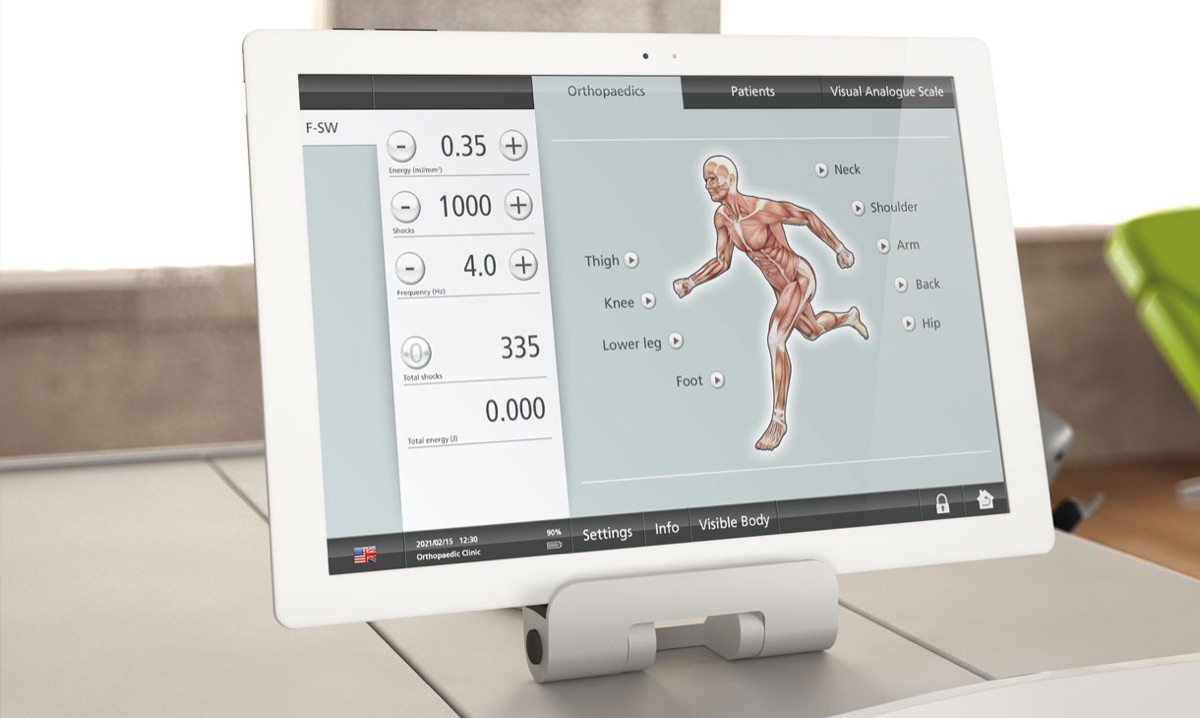
Every session is set on the control screen: energy, number of pulses and frequency are recorded, so we can adjust treatment from one session to the next.
What happens at your appointment?
Free consultation. We ask about your symptoms, how long you’ve had them and what you’ve already tried. We examine the area and, where it helps, look at the tendon with ultrasound to check what’s causing the pain.
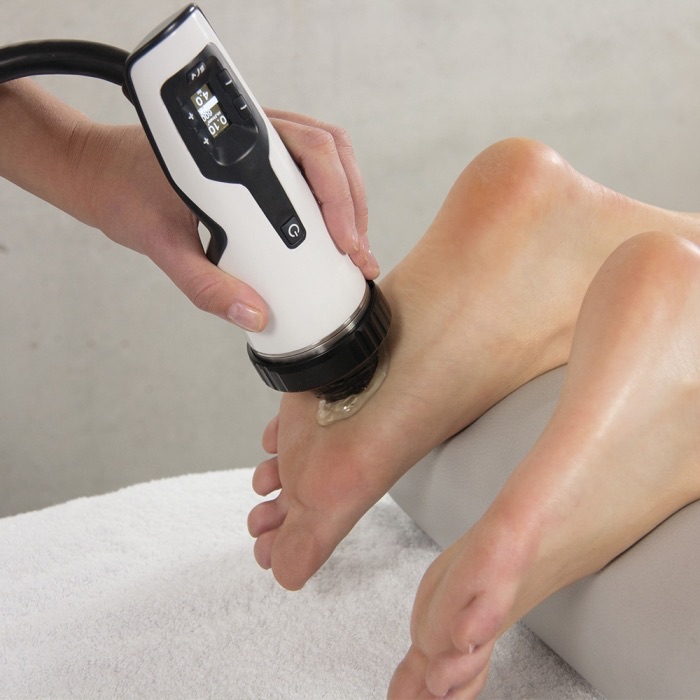
Treatment. Gel is put on the skin and the applicator is held over the sore area. Most people feel a firm tapping or pressure, which can be uncomfortable for a few minutes.
Afterwards. You can usually walk out and carry on with your day. We’ll give you exercises to do between sessions, because loading the tendon gradually is an important part of recovery.
Who it may help
Shockwave may help some people with:
plantar fasciitis (heel pain) that hasn’t improved after several months of exercise and footwear changes
tennis elbow or golfer’s elbow that hasn’t settled with rest and strengthening
Achilles tendinopathy (pain and stiffness at the back of the heel or lower calf)
Calcific tendonitis of the shoulder
In calcific tendonitis, calcium deposits build up in one of the rotator cuff tendons, often causing pain when lifting the arm and at night. Focused shockwave has been studied for this in a number of trials [3]. Two meta-analyses, which pool the results of several studies, found that people who had focused shockwave reported less pain and better shoulder function than those given other treatments or a placebo, and that calcium deposits often became smaller [1, 2]. Higher-energy treatment generally did better than lower-energy treatment [1].
The evidence isn’t settled, though. The studies vary in quality and in how they were carried out, and a 2022 UK review of the evidence concluded that more research is needed before shockwave becomes a routine treatment for this condition. Not everyone improves, and some people go on to need other treatment.
So we only discuss shockwave for calcific tendonitis after a full assessment and an ultrasound scan, and after explaining the uncertainty and the other options, such as exercise-based rehabilitation and ultrasound-guided injections. If you decide to go ahead, we’ll give you written information and ask for your written consent.
It isn’t the right treatment for every cause of heel or elbow pain. Nerve pain, stress fractures and arthritis can feel similar, and they need a different approach.
When to get urgent help
Seek urgent medical advice if a painful heel, ankle or elbow becomes hot, red and swollen with a fever, or if you suddenly can’t put weight on your leg after an injury or felt a snap at the back of the ankle. These need prompt assessment rather than shockwave.
Severe plantar fasciitis. Had several sessions with Gary, shockwave therapy. Really has settled down well. Gary provides calm reassurance coupled with great knowledge and expertise in the field.
Graham C. · 2026 · Google review
Plantar fasciitis★★★★★
Gary is very knowledgeable and has given me lots of great advice and the treatment has been great! My pain levels are much better… Booking was easy using the online system and Gary has been very helpful and friendly.
Emily C. · 2023 · Google review
Plantar fasciitis★★★★★
I’ve just had my 6th treatment for plantar fasciitis and I am very happy with the reduction in pain so far. Gary has been so informative and invested in my healing process.
Olivia M. · 2025 · Google review
Achilles tendinopathy★★★★★
Gary was a great help, in particular his recommendations on using the balance pad to strengthen surrounding tendons… It took a long time to notice any major improvement… Give it a go, but please don’t expect it to work quickly and solve everything.
Max E. · 2026 · Google review
Achilles tendinopathy★★★★★
After an initial consultation with Gary for achilles tendonitis, an ultrasound scan followed by shockwave treatment, I then had weekly sessions over a period of 2 months… The shockwave results weren’t instantaneous and the pain sometimes fluctuated.
Mel R. · 2025 · Google review
Calcific tendonitis★★★★★
Attended Gary at the Vale Health Clinic for chronic shoulder calcific tendinopathy… Gary was informative, without being condescending, and explaining everything he was doing and why, as well as being personable and chatty!
Alison W. · 2026 · Google review
Tennis elbow★★★★★
I have had 5 sessions with Gary, and so far things are going really well. I am not totally pain free but am now able to do most things without a problem. He gave me gentle exercises to do… Gary is very knowledgeable and takes time to listen to you.
Shockwave therapy in Tunbridge Wells questions answered
Which type will I have, radial or focused?
It depends on your condition, how deep the problem tissue is and how sensitive the area is. Radial suits larger, closer-to-the-surface areas; focused can reach deeper, smaller targets more precisely. Sometimes both are used in the same course. We’ll explain our choice at your consultation.
Does shockwave therapy hurt?
It can be uncomfortable while the applicator is working, especially over the most tender spot. We can turn the intensity down, and the discomfort stops when the session ends.
Are there any risks or side effects?
Most people have nothing more than temporary redness, mild bruising or extra soreness for a day or two. It isn’t suitable for everyone, for example during pregnancy, with some blood-clotting problems or blood-thinning medicines, or over an area with an infection or tumour. We check this at your consultation.
How many sessions will I need?
Usually between 3 and 8 sessions. The number depends on what your ultrasound scan shows and how long you’ve had the problem: longer-standing problems often need more. We review how you’re doing as you go, rather than booking a fixed number up front, and we’ll tell you if it isn’t helping.
Will it definitely work?
No treatment works for everyone. Research results for shockwave are mixed and vary between conditions, so we’ll explain what’s realistic for your problem before you decide, along with the alternatives.
Can I claim on my health insurance?
It depends on your insurer and policy. AXA Health covers some forms of shockwave therapy. We aren’t recognised by Bupa. With other insurers, you pay us for your treatment and then claim the cost back from your insurer, if your policy covers it. Please check with your insurer before your first session.
Got another question?Ask us at your consultation. You don’t have to go ahead.
ClinicVale Health Clinic, 31–33 Vale Road, Tunbridge Wells TN1 1BS
References
Vavken P, Holinka J, Rompe JD, Dorotka R. Focused extracorporeal shock wave therapy in calcifying tendinitis of the shoulder: a meta-analysis. Sports Health 2009;1(2):137–144. doi:10.1177/1941738108331197
Forogh B, Karami A, Bagherzadeh Cham M. Effect of extracorporeal shock wave therapy and ultrasound-guided percutaneous lavage in reducing the pain of rotator cuff calcific tendinopathy: an updated systematic review and meta-analysis. J Orthop 2024;56:151–160. doi:10.1016/j.jor.2024.05.023
Moya D, Ramón S, Guiloff L, et al. Current knowledge on evidence-based shockwave treatments for shoulder pathology. Int J Surg 2015;24:171–178. doi:10.1016/j.ijsu.2015.08.079
Written by Gary Edwards, Chiropractor (GCC 03996). Last updated 15 October 2026.