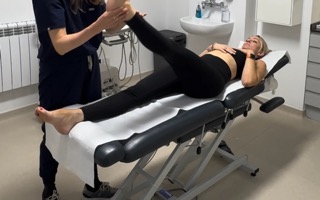
A trapped nerve in the lower back usually causes pain down the buttock and leg, known as sciatica. Most cases improve within weeks to a few months. Gentle exercises and staying active can help you move more comfortably while it settles. Bed rest doesn’t speed things up [1].
Below are the exercises commonly used, how to do them safely, and the warning signs that need urgent care.
What is a trapped nerve in the back?
Nerve roots leave the spine through small openings between the vertebrae. In the lower back, several of them join to form the sciatic nerve, which runs through the buttock and down the back of the leg.
If a nerve root is pressed on or inflamed, you feel symptoms along the nerve’s path. That’s why a problem in the back can cause pain in the calf or foot. Estimates of how many people get sciatica vary widely between studies, depending on how it’s defined [2].
What causes it?
A disc bulge or herniation. This is the most common cause in younger and middle-aged adults. Part of a disc pushes out and irritates a nearby nerve root. Read more about lumbar disc bulges.
Spinal stenosis. Age-related narrowing of the spinal canal or nerve openings. Leg symptoms often come on with walking or standing and ease when you sit or bend forward.
Spondylolisthesis. One vertebra slips forward on the one below, narrowing the space for the nerve.
Piriformis syndrome. The sciatic nerve may be irritated as it passes the piriformis muscle in the buttock. How often this happens is debated, and other causes should be ruled out first.
Symptoms
- pain from the lower back or buttock down the leg, often below the knee;
- pins and needles or numbness in the leg or foot;
- weakness, such as difficulty lifting the foot or standing on tiptoe;
- pain that’s worse with sitting, coughing, sneezing or bending.
Leg pain is often worse than back pain. Back pain on its own, without leg symptoms, is usually not a trapped nerve.
Does exercise help?
Exercise and staying active are standard advice, but the research on specific exercise programmes for sciatica is weaker than many people expect. A 2023 review of physiotherapy treatments for sciatica found the trials too varied and too low in quality to make firm recommendations [3].
Nerve gliding exercises, sometimes called neural mobilisation, gently move the nerve without stretching it hard. A review found they reduced pain and disability in people with low back pain, but called for better-quality studies [4].
In practice, gentle exercise helps many people stay mobile and confident while the nerve recovers. The best exercises vary from person to person, which is why an assessment is useful.
Before you start
Move slowly and stay within a comfortable range. Mild discomfort is fine.
Watch where the pain goes. If an exercise pushes pain further down your leg, or increases numbness, stop it. If the leg pain eases or moves up towards your back, that’s usually a good sign.
If you’re not sure the exercises suit you, get advice first.
Back exercises for a trapped nerve
Knee to chest
- Lie on your back with both knees bent and feet flat.
- Bring one knee towards your chest, holding behind the thigh.
- Hold for 20–30 seconds, breathing normally, then lower.
- Repeat 3 times on each side. You can also try both knees together.
Pelvic tilts
- Lie on your back with knees bent.
- Gently flatten your lower back into the floor by tightening your tummy muscles.
- Hold for 5 seconds, then relax.
- Repeat 10 times.
Lying press-ups
This can help some people whose pain is from a disc and eases when they stand up straight. Skip it if bending backwards makes your leg pain worse, or if you have spinal stenosis.
- Lie on your front with your hands under your shoulders.
- Keeping your hips on the floor, slowly push your upper body up as far as is comfortable.
- Hold for 1–2 seconds, then lower.
- Repeat up to 10 times.
Seated nerve glide
- Sit upright on a chair.
- Straighten the affected knee while lifting your head to look slightly upwards.
- Then bend the knee back down as you look down. The movement should feel smooth, not stretched.
- Repeat 10 times, slowly.
This should cause little or no pain. If it triggers leg symptoms, make the movement smaller.
Buttock stretch
- Lie on your back with knees bent.
- Cross the ankle of the painful side over the opposite knee.
- Gently pull the lower thigh towards your chest until you feel a stretch in the buttock.
- Hold for 20–30 seconds. Repeat 3 times.
Walking
Short, regular walks are one of the simplest ways to keep moving. Start with a few minutes at a time and build up.
Other things that may help
Avoid sitting for long periods, and get up every 20–30 minutes. Lying on your side with a pillow between your knees, or on your back with a pillow under your knees, can ease pain at night.
Simple painkillers may help in the short term. Ask a pharmacist what suits you. A large trial found that pregabalin, a nerve pain medicine, was no better than placebo for sciatica [5].
Hands-on treatment from a chiropractor or physiotherapist, combined with exercise, is an option for some people. Your clinician should explain what’s involved and any risks first.
When to get urgent help
Go to A&E straight away if you have back pain or sciatica with any of these. They can be signs of cauda equina syndrome, which needs emergency treatment:
- numbness or tingling between your legs or around your bottom or genitals;
- new problems passing urine, or loss of bladder or bowel control;
- sciatica in both legs;
- new difficulty getting an erection or loss of sensation during sex.
See a doctor the same day if your leg is getting weaker, or you have a fever, unexplained weight loss, a history of cancer, or pain after a fall or accident.
Next steps
If your symptoms haven’t started to improve after a few weeks, or you’re unsure which exercises are right, get an assessment. At Vale Health Clinic our chiropractors examine your back and nerves, explain the likely cause and tailor an exercise plan. A first appointment lasts 50 minutes and costs £70. Read more about back pain, or call 01892 543029.
For more general advice, see how to relieve pain from a trapped nerve.
References
- Vroomen PC, de Krom MC, Wilmink JT, Kester AD, Knottnerus JA. Lack of effectiveness of bed rest for sciatica. N Engl J Med 1999;340(6):418–423. doi:10.1056/NEJM199902113400602
- Konstantinou K, Dunn KM. Sciatica: review of epidemiological studies and prevalence estimates. Spine 2008;33(22):2464–2472. doi:10.1097/BRS.0b013e318183a4a2
- Dove L, Jones G, Kelsey LA, Cairns MC, Schmid AB. How effective are physiotherapy interventions in treating people with sciatica? A systematic review and meta-analysis. Eur Spine J 2023;32(2):517–533. doi:10.1007/s00586-022-07356-y
- Neto T, Freitas SR, Marques M, et al. Effects of lower body quadrant neural mobilization in healthy and low back pain populations: a systematic review and meta-analysis. Musculoskelet Sci Pract 2017;27:14–22. doi:10.1016/j.msksp.2016.11.014
- Mathieson S, Maher CG, McLachlan AJ, et al. Trial of pregabalin for acute and chronic sciatica. N Engl J Med 2017;376(12):1111–1120. doi:10.1056/NEJMoa1614292
This article is general information, not personal medical advice. Please speak to a clinician about your own situation.
This article is general information and isn’t a substitute for advice about your own health. If you’re worried about a symptom, speak to your GP or book an assessment.